Baital Pachisi: The Twenty-Five Tales of the Vetal Explained
بیتال پچیسی
Updated
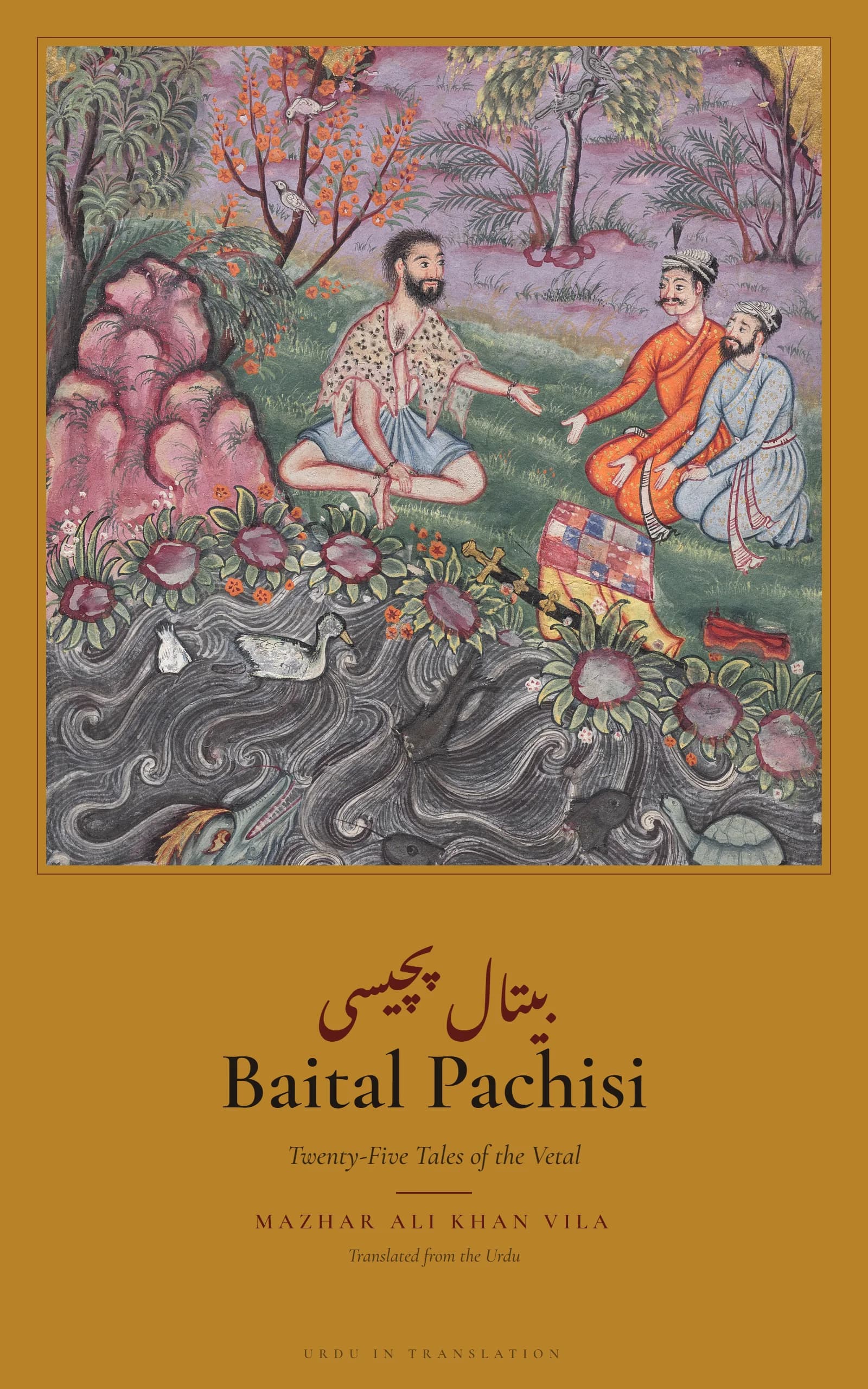
Baital Pachisi (بیتال پچیسی), the Twenty-Five Tales of the Baital (Vetal), is one of the oldest and best-loved story cycles of India. Its Urdu version was made in 1803 by Mazhar Ali Khan Vila at Fort William College in Calcutta, the same college that produced Bagh-o-Bahar, and it became a classic of early Urdu prose.
You can read Baital Pachisi in Urdu with a facing English translation; the first two chapters are free.
The frame story
A yogi asks King Bikram (Vikramaditya) to bring him a corpse that hangs from a tree in a cremation ground. Inside the corpse lives a spirit, the Baital. As the king carries it, the Baital tells a story and ends it with a question. If the king knows the answer and stays silent, his head will burst into pieces; if he answers, the corpse flies back to its tree and he must start again.
Twenty-four times the king answers, and twenty-four times he walks back. The twenty-fifth riddle has no answer, and his silence at last brings the corpse to the yogi, whose real plan, revealed by the Baital, gives the cycle its climax.
Some famous tales
The Transposed Heads (Tale 6): a woman restores her husband and brother to life but puts each head on the other's body. Which one is her husband? The king answers that the head decides, since the head rules the body. Thomas Mann retold this story as The Transposed Heads.
The Three Delicate Queens (Tale 10): one queen is bruised by a falling lotus petal, another blistered by moonlight, the third pained by the sound of a pestle far away. Which is the most delicate?
The Four Who Made a Lion (Tale 21): four learned brothers use their skill to bring a lion to life, and it eats them. Which was the most foolish?
The Son of Three Fathers (Tale 18) and The Boy Who Laughed Before Dying (Tale 19) show the cycle's taste for paradox and its surprising moral judgements.
Why read it
Each tale is short, ends in a puzzle and invites argument, which makes the book ideal for reading aloud and for learners of Urdu: try to answer the riddle before you read the king's reply. Learn more about the translator in our guide to Mazhar Ali Khan Vila.
Read it here
Questions and answers
What does Baital Pachisi mean?
Twenty-Five (Tales) of the Baital. Baital is the Urdu and Hindi form of Vetala, a spirit that inhabits corpses.
Who wrote the Urdu Baital Pachisi?
Mazhar Ali Khan Vila, at Fort William College, Calcutta, in 1803. The stories themselves are far older and go back to the Sanskrit Vetalapanchavimshati.
Is Baital Pachisi the same as Vikram and Betaal?
Yes. The popular Indian television series Vikram aur Betaal is based on the same cycle of stories.
More guides
- Mazhar Ali Khan Vila: The Translator of Baital Pachisi · The Delhi poet who gave Urdu its Baital Pachisi at Fort William College.
- Bagh-o-Bahar: The Tale of the Four Darvesh Explained · The classic Urdu dastan of King Azad Bakht and the four wandering dervishes.